



 Safes
Safes 
Lithium-ion battery safe tested: Batteryguard XL lithium-ion safe
There are now several parties in the market offering battery storage cabinets that claim they can withstand the force of a lithium-ion battery fire and possible explosions. In the absence of concrete European regulations, it is not clear whether all the cabinets offered are indeed safe.
Safe battery storage is very important. This is why Nauta took the lead and asked test institute MPA Dresden to test the Batteryguard XL lithium-ion battery safe. Result: fire and explosions remain in the safe! This is an important step towards proven safe storage of lithium-ion batteries. Read on below to find out exactly what this means.
Want to know more about the lithium-ion safe?
Test setup
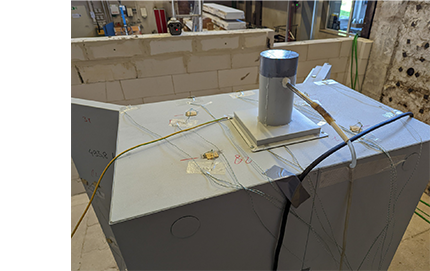
For this test, a Batteryguard XL lithium-ion safe was set up in a test laboratory and fitted with temperature and pressure sensors at all critical points. As many as 20 fully charged lithium-ion batteries were placed in the safe.
One of the batteries, centrally placed in the safe, was then put into a thermal runaway to simulate a real situation in which a failed battery spontaneously ignites.
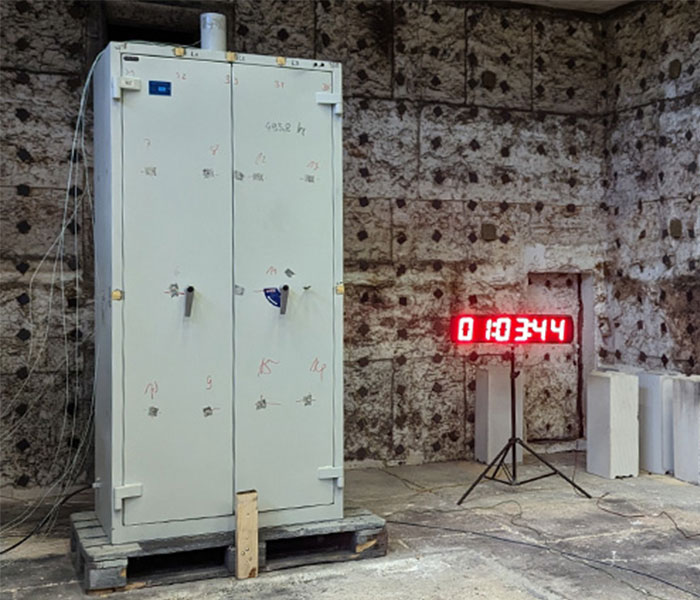
Fierce fire and explosions during test
Despite a fierce fire and explosions taking place inside the safe, very little smoke could be seen on the outside. The smoke that did escape was largely vented naturally to the outside through the flue pipe.
Test results:
- Fires and explosions remain inside the safe.
- Smoke is exhausted through flue pipe.
- Doors remain closed during the fire and battery explosions.
- No damage to the premises.
- No dangerous situation for staff.
- Sufficient time to alert the emergency services.
What is a thermal runaway?
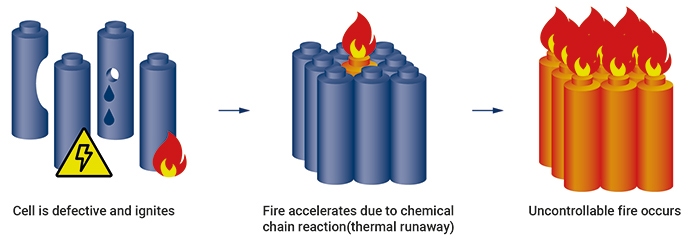
Lithium-ion batteries are made up of cells. If a cell fails, it can ignite. The fire then accelerates due to a chemical chain reaction, this is called the thermal runaway.
An uncontrollable fire occurs where the battery can explode, with all its consequences.
Test conducted by MPA Dresden
Because there are still no European regulations for the safe storage of lithium-ion batteries, Nauta took the initiative and commissioned a fire test on the Batteryguard XL lithium-ion battery safe.
The test protocol for this was drawn up by the Dutch safe industry and insurance companies. The German test institute MPA Dresden (part of Kiwa Group) then conducted and documented the test.
With this test report in hand, Nauta has taken a big step towards proven safe storage of lithium-ion batteries!
Risks in storage of lithium-ion batteries
Lithium-ion batteries need to be handled with care. The slightest damage can cause a battery to catch fire. This is even more likely during charging.
If a battery is damaged due to damage or a production error, a chain reaction can occur during charging, causing the battery to catch fire and, in the worst case, even explode. The problem is that you often cannot tell from the outside if a battery is damaged internally.
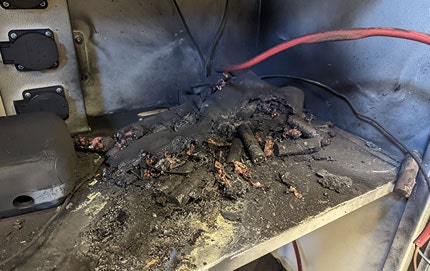
Current EN 14470-1 standard inadequate?
The EN 14470-1 standard used for the storage of lithium-ion batteries is originally designed for the storage of flammable substances and therefore not adequate for the storage of lithium-ion batteries.
An EN 14470-1 cabinet protects the contents of the cabinet from an external fire, but in the case of lithium-ion batteries, a fire actually occurs inside the cabinet. Most battery cabinets that only comply with EN 14470-1 are fire-resistant, but have a simple lock on the door and therefore do not seem to be able to withstand a violent battery fire.
